LPPC Releases New FEMA Reform Report: Supporting Mutual Aid, Expediting Disaster Recovery, & Enhancing Resiliency
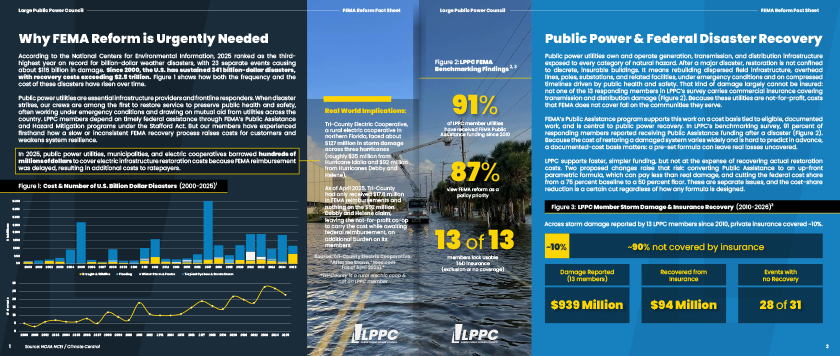
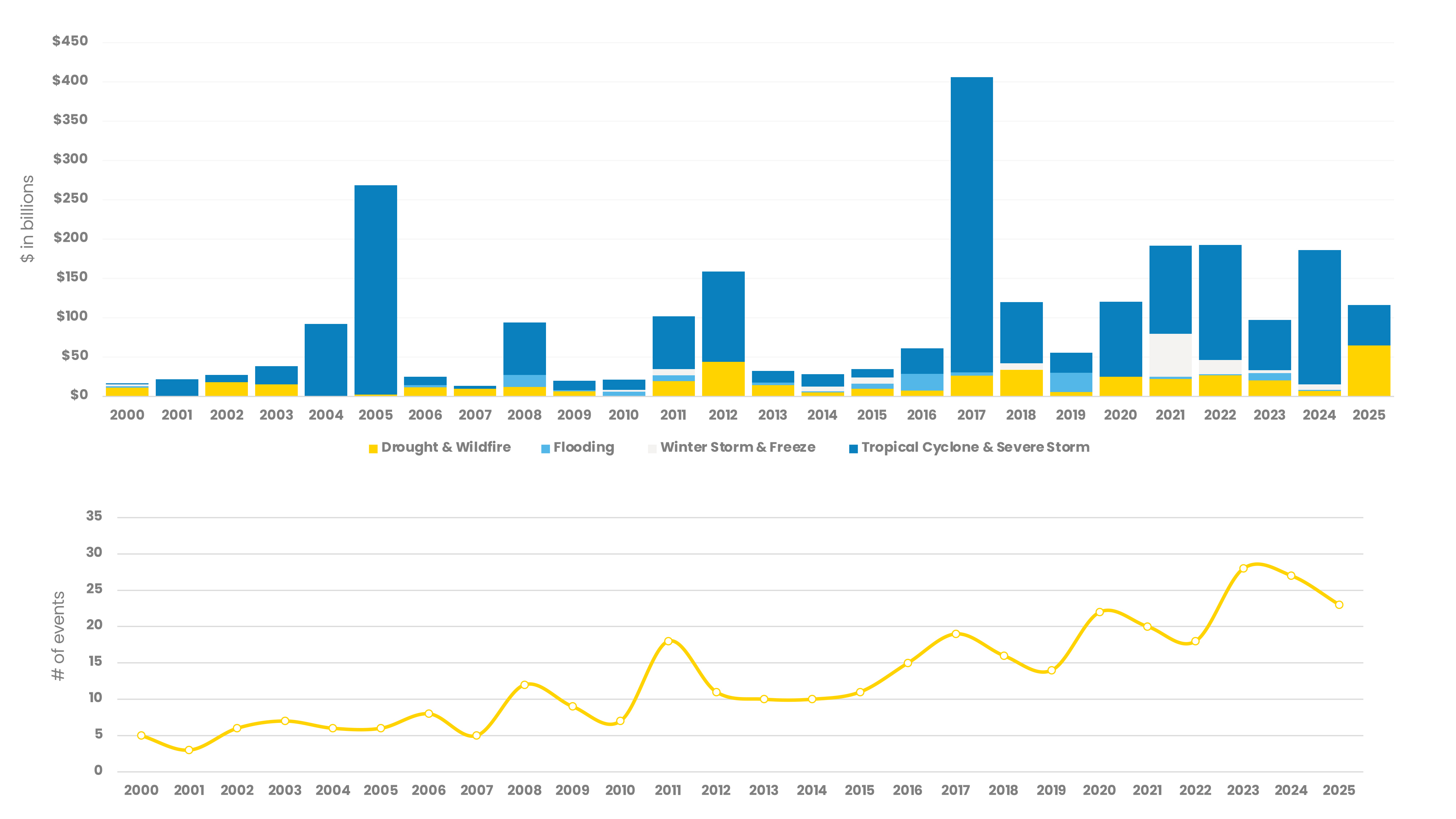
As Congress considers reforms to the Federal Emergency Management Agency (FEMA), public power utilities support efforts to make disaster recovery faster, simpler, and more predictable. But reform must not come at the expense of the communities that rely on critical electric infrastructure every day.The need for effective disaster recovery has never been greater. In 2025, the U.S. experienced 23 billion-dollar disasters causing approximately $115 billion in damage. Since 2000, there have been over 341 billion-dollar events, with more than $2.5 trillion in recovery costs (see figure 1).

Figure 1: Cost & Number of U.S. Billion Dollar Disasters  (2000-2025)
Public power utilities are on the front lines of these events. When hurricanes, tornadoes, floods, wildfires, and winter storms strike, public power crews work around the clock to restore service and protect public health and safety. Those restoration efforts often depend on FEMA's Public Assistance program, which helps communities recover eligible disaster costs.

Unfortunately, many LPPC member utilities have experienced firsthand how FEMA's current processes can delay recovery and increase costs. Lengthy reimbursement timelines often force utilities to borrow substantial sums to finance restoration work while waiting for federal assistance. Those financing costs ultimately fall on customers and local communities.

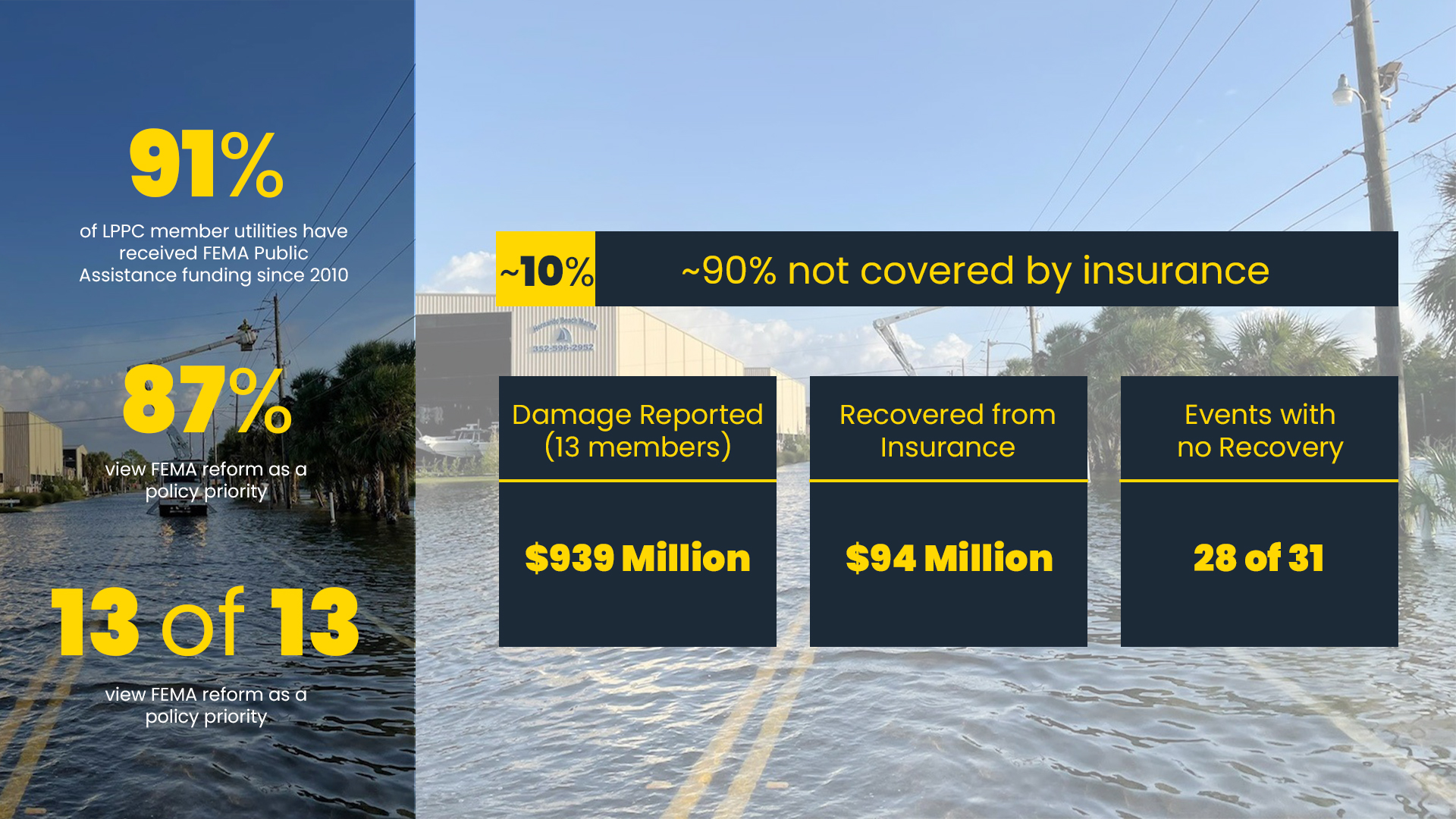
While utilities can insure certain facilities, most electric system restoration costs are not commercially insurable. Mutual aid, emergency labor, debris removal, damaged poles and wires, transportation, and system-wide restoration efforts generally fall outside traditional insurance coverage. LPPC survey data found that the commercial market does not offer meaningful coverage for transmission and distribution system damage, and insurance covered only a small fraction of storm-related restoration costs reported by members (see figure 2).

Figure 2: LPPC FEMA Benchmarking Study & Member Storm Damage / Insurance Recovery  (2010-2026)
That is why FEMA remains an essential federal backstop when disasters exceed local and state capacity.

In its comments to the Department of Homeland Security, LPPC evaluated the major FEMA reform proposals currently under consideration, including the FEMA Review Council's Final Report and H.R. 4669, the Fixing Emergency Management for Americans Act. While both seek to improve disaster recovery, LPPC believes successful reform should be guided by several key principles, including:

1 - FEMA must remain a reliable federal partner during catastrophic events. Recovery programs should continue to provide predictable support when disasters overwhelm local resources.

2 - Reforms should accelerate funding without reducing the ability of utilities and communities to recover documented restoration costs. Faster assistance is important, but speed should not come at the cost of shifting financial risk to disaster victims.

3 - Insurance requirements should remain realistic. Insurance can complement federal assistance where coverage is available and practical, but it cannot replace FEMA for the vast majority of electric system restoration expenses.

4 - Recovery programs should encourage resilience by allowing utilities to rebuild damaged infrastructure to modern utility standards and incorporate mitigation measures during restoration.

5 - FEMA should support prudent preparedness efforts, including mutual aid and pre-positioning of crews and equipment ahead of forecasted disasters. Utilities should not be penalized for taking reasonable steps to protect communities simply because a storm changes course.

LPPC supports advancing H.R. 4669 because it preserves FEMA's documented-cost recovery framework, maintains the current 75 percent federal cost-share baseline, and includes measures designed to speed funding and improve program administration. At the same time, LPPC has urged policymakers to strengthen the legislation by clearly recognizing utility standards in rebuilding, improving treatment of pre-positioning costs, and ensuring adequate utility expertise within the disaster recovery process.

As discussions about FEMA reform continue, policymakers should focus on a simple goal: helping communities recover faster while preserving reliable and adequate federal support.

The nation needs a disaster recovery system that works better. With thoughtful reforms, Congress and the Administration can modernize FEMA while preserving the federal partnership that communities depend on when they need it most.


Read LPPC FEMA Reform Report →

LPPC Releases New FEMA Reform Report: Supporting Mutual Aid, Expediting Disaster Recovery, & Enhancing Resiliency
Bond Buyer Quotes LPPC in its Article "Public Power Alarmed by FEMA Reform"
LPPC Submits Comments to DHS on the Final Report of the President’s FEMA Review Council
LPPC Member's 2026 Interconnection Queues & Large Load Tariffs
President Tom Falcone Quoted in Bond Buyer Article: "Data Center Financing Assumptions Under Scrutiny"
Spring CEO Meeting
LPPC President Tom Falcone & President/CEO of Santee Cooper Jimmy Staton Share Perspectives on Large Loads at The Bond Buyer's Southeast Public Finance Conference
Nebraska Public Power District President and CEO Tom Kent Discusses How Permitting Delays Have Real Consequences to Reliability and Affordability
LPPC's Priorities on FEMA Reform
Public Power, Disaster Recovery, and FEMA
LPPC Names Sarah Vilms Senior Director of Policy and External Affairs
Tom Talk Episode 3: U.S. Department of the Treasury's Private Use Rules: The Problem Explained
LPPC President Tom Falcone Testifies Before House Energy and Commerce Subcommittee on Energy
Santee Cooper President and CEO Jimmy Staton Discusses Permitting Reform
LPPC Releases New Report | Priorities for Permitting Reform: Supporting Electric Reliability, Affordability, and Growth
LPPC Comments on FERC Docket on Large Load Interconnection
Grid Reliability, Retirements, and New Entry to Meet AI and Load Growth Leavebehind
LPPC Releases New About One-Pager
Bring FEMA Act to the Floor: Nearly Half of House Representative Signatures on Bipartisan Letter to Leadership Represent LPPC Member Districts
LPPC Shares Letter to House Committee on Energy & Commerce's Subcommittee on Energy Prior to FERC Oversight Hearing
LPPC Signs on to Letter to U.S. Senate Urging Permitting Reform Legislation
The Grid Nobody Planned For: Public Power, Hyperscalers and the Race to Rewire America for the AI Age
LPPC Winter CEO Meeting
Public Power is Powering the Future of America’s Economy: LPPC Publishes NEW Private Business Use Report
As AI Booms, Data Centers May Create Electricity Scarcity Among Users
Energy Evolution Podcast: The race to rebuild the US power grid in the age of AI
Public Power's Response to Increased Energy Demand
To Maintain Energy Security and Win the AI Race, Federal Policy Must Take Proactive Steps to Unleash Public Power
How Increased Energy Demand Could Affect American Families
NPPD, OPPD, LES and GRDA Launch Joint Effort to Explore Advanced Nuclear Energy
LPPC Submits Comments to FERC on Proceeding on Interconnections for Data Centers and Large Loads
‘Phantom’ data centres muddy forecasts for US power needs
America's Future Growth Depends on Building New Energy Infrastructure Today
LPPC President Highlights Public Power’s Role in Meeting AI-Driven Energy Demand
LPPC President Joins USEA for Virtual Press Briefing on AI in the Electric Utility Space
The Bond Buyer Podcast: Surging energy demand, federal headwinds, and the $140B public power buildout
The POWER Podcast: Advocating for Public Power Companies
Public Power Leaders Discuss Surging Load, Reliability, Affordability, and Sustainability with Investors and the Financial Community
US public power sector weighs risks and rewards of data center customers
Large Public Power Utility CEOs Convene in New York to Tackle Surging Electricity Demand
Data Centers That Don’t Exist Yet Are Already Haunting the Grid
Meeting AI Power Demand Means More Renewables, Grid Officials Say
RTO Insider Covers LPPC at USEA Virtual Press Briefing
The Outdated Tax Rule Holding Back Big Infrastructure
LPPC Supports Bipartisan FEMA Reform Bill to Strengthen Disaster Recovery
LPPC Thanks White House & Congress for Supporting Public Power Communities
Triple Digit Temperatures are Coming, and Public Power is Ready
LPPC Calls for FEMA Reform While Emphasizing Need for Continued Federal Grants
Industry Groups Back FEMA as ‘Essential’ Disaster Agency
LPPC Member CEOs Head to Capitol Hill
The Hidden Costs of Eliminating Energy Tax Credits
Public Utilities Would Feel Pain if Muni Tax Exemption Goes
LPPC Op-ed: Growing Demand for Electricity Requires New Policy Solutions
LPPC Welcomes EPA’s Decision To Reconsider The Power Plant CO2 Rule
Forbes Covers LPPC at USEA Press Briefing
Bill restoring tax-exempt advance refunding introduced in House
Gov. Hochul looks to advance nuclear power as wind energy faces headwinds
What is and isn’t in Trump’s National Energy Emergency Order
Policy Outlook for 2025: Everything Leads Back to Demand
Is Public Power a Better Model for Meeting Data Center Demand?
LPPC’s Post-Election Forum Convenes Policymakers and Public Power Leaders to Address Rapidly Growing Demand for Electricity
LPPC President-Elect: Treasury’s New Elective Pay Guidance a “Significant Step Forward” for Public Power Customers
Rising Electric Demand Calls for Solutions
LPPC Ready to Partner with President and Congress to Power Growth
The State of Public Power Advocacy: John Di Stasio & Tom Falcone Share Their Insights
President’s Post: The Connection Between Federal Energy Policy & Clean Energy
Large Public Power Council Announces Tom Falcone as President-Elect
LPPC Grows Membership with the Addition of Lincoln Electric System
LPPC Announces Jackie Flowers and Javier Fernandez as New Chair and Vice Chair
LPPC Responds to FERC’s Final Transmission Planning Rule
LPPC Issues Statement on EPA's Final Power Plant Rule
Public Power Leaders Attend LPPC’s Inaugural Members Conference
Broad coalition floats cost containment proposal as FERC eyes final grid rule
Groups Urge Inclusion of Cost Containment in FERC Tx Planning Rule
Energy Groups Press Regulators to Scrutinize Power Grid Costs
LPPC and Advocacy Groups Advance Transmission Planning Cost Management Proposal at FERC
LPPC Discusses Electrification at USEA's 2024 State of the Energy Industry Forum
PUF Covers LPPC Grid Reliability Event with Sen. Kevin Cramer
LPPC Hosts a Discussion on Reliability with Sen. Kevin Cramer (R-ND)
Where Community Matters Most
LPPC Announces Tom Falcone, CEO of LIPA, and Jackie Flowers, Director of Utilities at Tacoma Public Utilities, as New Chair and Vice Chair
Commentary: Look no further than Long Island for a case for public power
Navigating the Path to a Sustainable and Reliable Power Supply
Clearing the Path for Permitting Reform
Leading on Clean Energy Expansion
Fitch Says Deleveraging Era Over For Public Power Utilities
LPPC Welcomes Nashville Electric Service as Newest Member
IRS guidance on renewable tax credit transferability, direct-pay provisions of IRA, garners mixed reviews
Treasury Proposes Rules on Monetizing Energy Tax Credits
Domestic Content Rules for Direct Pay Continue to Lack Clarity and Certainty
President’s Post: Permitting Reform & Protecting Direct Pay Priorities as LPPC CEOs Meet with Members of Congress
US Releases Made-in-America Rules for Clean Energy Credits
LPPC Calls for Certainty and Clarity on Domestic Content Requirements
Can Utilities Rise To The Challenges Presented By Decarbonization?
Panel Debates Impact of Renewables, Electrification on Reliability
To Electrify America, Advance Permitting Reform
LPPC Discusses Pathways to Decarbonization at USEA’s 2023 State of the Energy Industry Forum
LPPC Discusses Clean Energy Tax Credits and Decarbonization with Bloomberg Government
President's Post: Public Power CEOs and Federal Policymakers Convene at LPPC's Post-Election Forum
LPPC CEOs Present at the Public Power Community Forum