LPPC Releases New FEMA Reform Report: Supporting Mutual Aid, Expediting Disaster Recovery, & Enhancing Resiliency
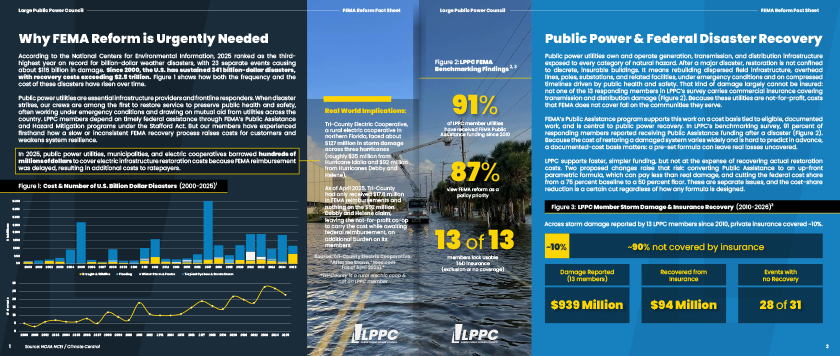
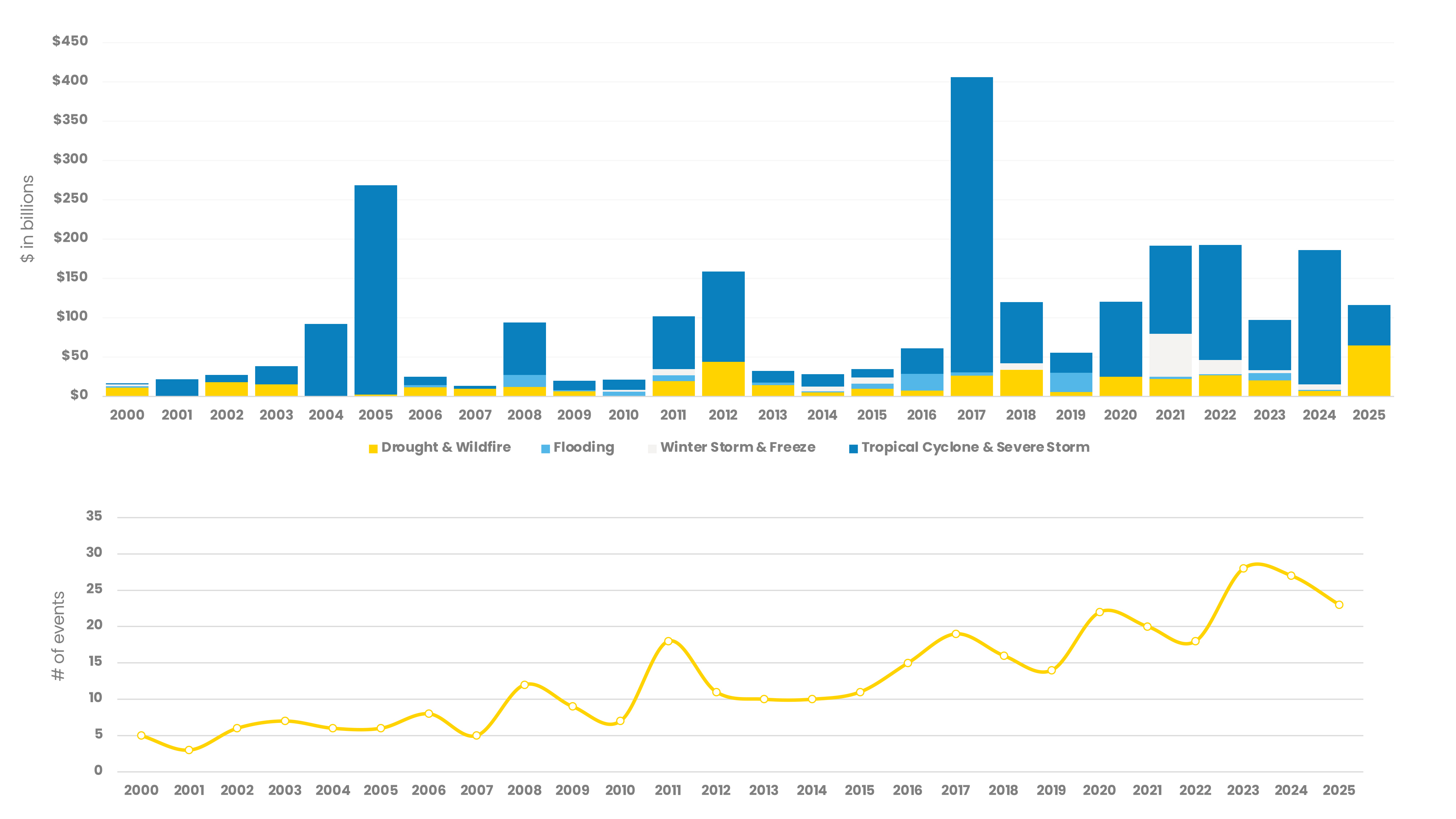
As Congress considers reforms to the Federal Emergency Management Agency (FEMA), public power utilities support efforts to make disaster recovery faster, simpler, and more predictable. But reform must not come at the expense of the communities that rely on critical electric infrastructure every day.The need for effective disaster recovery has never been greater. In 2025, the U.S. experienced 23 billion-dollar disasters causing approximately $115 billion in damage. Since 2000, there have been over 341 billion-dollar events, with more than $2.5 trillion in recovery costs (see figure 1).
Figure 1: Cost & Number of U.S. Billion Dollar Disasters (2000-2025)
Public power utilities are on the front lines of these events. When hurricanes, tornadoes, floods, wildfires, and winter storms strike, public power crews work around the clock to restore service and protect public health and safety. Those restoration efforts often depend on FEMA's Public Assistance program, which helps communities recover eligible disaster costs.
Unfortunately, many LPPC member utilities have experienced firsthand how FEMA's current processes can delay recovery and increase costs. Lengthy reimbursement timelines often force utilities to borrow substantial sums to finance restoration work while waiting for federal assistance. Those financing costs ultimately fall on customers and local communities.
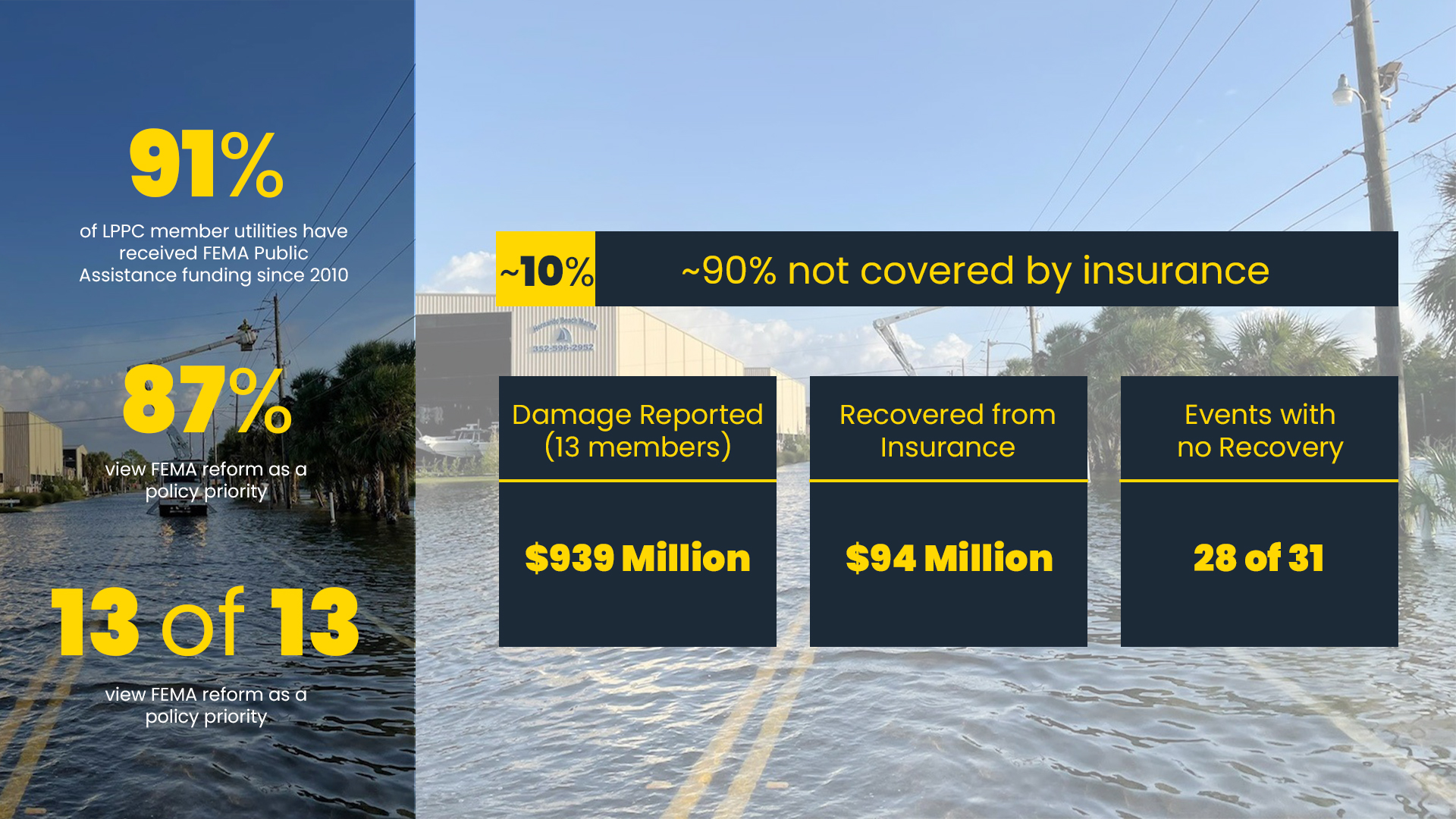
While utilities can insure certain facilities, most electric system restoration costs are not commercially insurable. Mutual aid, emergency labor, debris removal, damaged poles and wires, transportation, and system-wide restoration efforts generally fall outside traditional insurance coverage. LPPC survey data found that the commercial market does not offer meaningful coverage for transmission and distribution system damage, and insurance covered only a small fraction of storm-related restoration costs reported by members (see figure 2).
Figure 2: LPPC FEMA Benchmarking Study & Member Storm Damage / Insurance Recovery (2010-2026)
LPPC Member FEMA Benchmarking Study | December 2025
24 respondents 3 LPPC Member FEMA Insurance Proceeds Survey | May 2026, 13 respondents
That is why FEMA remains an essential federal backstop when disasters exceed local and state capacity.
In its comments to the Department of Homeland Security, LPPC evaluated the major FEMA reform proposals currently under consideration, including the FEMA Review Council's Final Report and H.R. 4669, the Fixing Emergency Management for Americans Act. While both seek to improve disaster recovery, LPPC believes successful reform should be guided by several key principles, including:
1 - FEMA must remain a reliable federal partner during catastrophic events. Recovery programs should continue to provide predictable support when disasters overwhelm local resources.
2 - Reforms should accelerate funding without reducing the ability of utilities and communities to recover documented restoration costs. Faster assistance is important, but speed should not come at the cost of shifting financial risk to disaster victims.
3 - Insurance requirements should remain realistic. Insurance can complement federal assistance where coverage is available and practical, but it cannot replace FEMA for the vast majority of electric system restoration expenses.
4 - Recovery programs should encourage resilience by allowing utilities to rebuild damaged infrastructure to modern utility standards and incorporate mitigation measures during restoration.
5 - FEMA should support prudent preparedness efforts, including mutual aid and pre-positioning of crews and equipment ahead of forecasted disasters. Utilities should not be penalized for taking reasonable steps to protect communities simply because a storm changes course.
LPPC supports advancing H.R. 4669 because it preserves FEMA's documented-cost recovery framework, maintains the current 75 percent federal cost-share baseline, and includes measures designed to speed funding and improve program administration. At the same time, LPPC has urged policymakers to strengthen the legislation by clearly recognizing utility standards in rebuilding, improving treatment of pre-positioning costs, and ensuring adequate utility expertise within the disaster recovery process.
As discussions about FEMA reform continue, policymakers should focus on a simple goal: helping communities recover faster while preserving reliable and adequate federal support.
The nation needs a disaster recovery system that works better. With thoughtful reforms, Congress and the Administration can modernize FEMA while preserving the federal partnership that communities depend on when they need it most.