Contrary to Federal Policy, Treasury Regulations Penalize Public Power for Requiring Data Centers to Pay Their Full Cost of Service
97 gigawatts of new demand

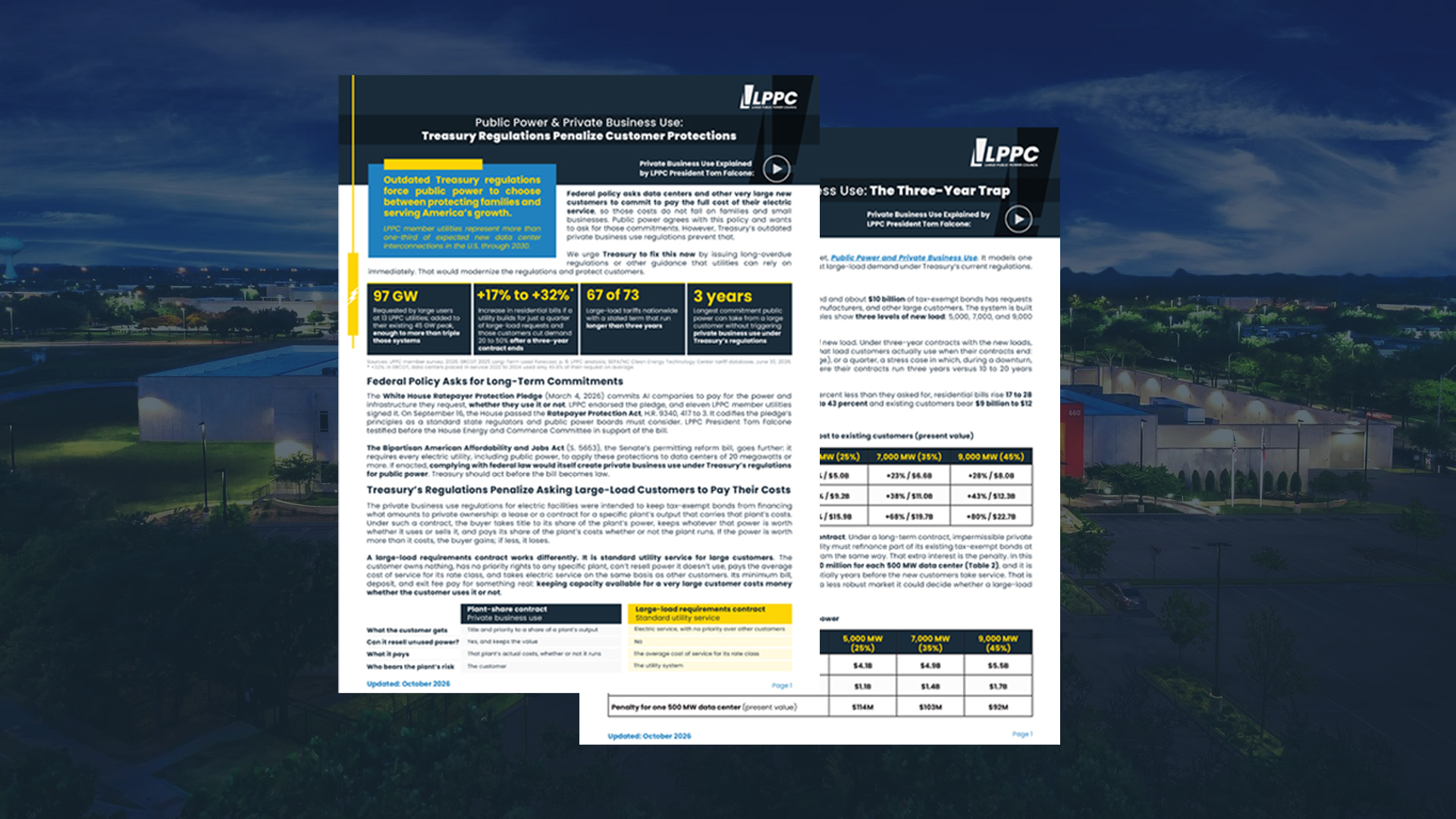
Data centers and other large users have asked 13 LPPC members for 97 gigawatts (GW) of new service. That is more electricity than all of Texas used on its hottest day.

Following federal policy, the rest of the industry is moving to data center commitments of 10 to 20 years. Treasury's private business use regulations hold public power utilities financed with tax-exempt bonds to three years, making public power the "free option" for large-load customers. With a three-year commitment, a data center can have public power build plants and power lines financed over decades, then walk away. In a downturn, it can cut its obligations to public power first.

The three-year trap:

If a data center scales back when its contract ends, existing customers pay for the capacity left behind. Across the 13 LPPC members facing 97 GW of requests, three-year contracts expose existing customers to $23 billion to $74 billion of extra cost, depending on how much of their requested power data centers use.

If the 13 members build for 25% of the 97 GW, residential bills at the hardest-hit systems rise:

  • 22% or more if data centers use 20% less than they requested.
  • 40% or more if they use half, as data centers in Texas have on average.
  • 71% or more if they use only a quarter.

The catch:

The obvious answer is a longer commitment. Most of the industry already uses one: of the 73 large-load tariffs nationwide that set a contract term, 67 run longer than three years.

For public power, a contract longer than three years counts as private business use the day it is signed. In the example above, LPPC members would have to refinance $13 billion of existing tax-exempt bonds at taxable rates and finance their ongoing capital programs at taxable rates. That tax penalty comes to $4.4 billion, or about $90 million for a single 500-megawatt data center.

No investor-owned utility faces these costs. Public power customers pay either way: for capacity left behind under a three-year contract, or a tax penalty under a longer one.

Treasury can fix this:

The three-year limit is a regulatory choice, not a statutory one. In 1972, Treasury held that contracts with demand charges or minimum payments were not private business use, and Congress endorsed that approach in 1986. Treasury reversed course in 2002 without any new law requiring it.

Washington is already moving to protect electric customers. In March, the White House launched the Ratepayer Protection Pledge; in July, LPPC endorsed it and 11 LPPC members signed it. On Sept. 16, the House passed the Ratepayer Protection Act, 417-3. On Sept. 30, S. 5653, the Bipartisan American Affordability and Jobs Act, was introduced in the Senate. The permitting reform bill would require utilities to have long-term contracts with data centers of 20 megawatts or more, so that data centers pay their full cost.

The Senate aims to take up S. 5653 when it returns in November. If the bill becomes law before Treasury acts, utilities would be required to sign the long-term contracts that Treasury's regulations penalize, and each one would put the tax-exempt status of the utility's bonds at risk the day it is signed. Public power cannot sign those contracts and wait months for guidance. Treasury should issue regulations or other guidance that public power utilities can rely on immediately.

New from LPPC:

  • Case study: The Three-Year Trap. Our new analysis models what three-year and long-term contracts would cost an illustrative system and the 13 LPPC members facing the most demand. Read the case study →
  • Fact sheet: Public Power and Private Business Use. A two-page overview of the problem, the numbers, and the fix. Download the fact sheet →
  • Updated regulatory text. Our proposed revision to Treasury's private business use regulations would restore the pre-2002 treatment of large-load contracts. View the regulatory text →
Contrary to Federal Policy, Treasury Regulations Penalize Public Power for Requiring Data Centers to Pay Their Full Cost of Service
LPPC Releases New Economic Impact Study "Public Power at Work: The Economic Contribution of LPPC Members"
Securing America's Electric Grid: Public Power's Recommendations for a More Secure, Reliable, and Affordable Supply Chain
LPPC Member Utility CEOs Stuart Reilly of Austin Energy & Rudy Garza of LCRA Welcome Public Power Leaders to the 2026 Members Conference in Austin, Texas
LPPC thanks SPP CEO Lanny Nickell for Joining CEOs at its Fall Meeting in Fort Collins, Colorado
LPPC President Tom Falcone Joins Panel with Industry Leaders from PG&E, ERock, and CEBA at CRES' 2026 Clean Energy Week Policymaker Symposium
LPPC Urges Senate to Advance Hydropower Licensing Affordability Act
Prepaid Energy Transactions Deliver Billions in Savings for Public Power Customers
LPPC Urges FCC to Protect Critical Infrastructure Drone Operations
LPPC CEOs Convene in South Carolina for a Tour of the Fairfield Nuclear Project
On National Hydropower Day, LPPC Endorses H.R. 9806/S. 3518, the Bipartisan Fair Licensing for Operations of Water Structures (FLOWS) Act
LPPC Releases New Hydro-Relicensing Fact Sheet in Support of the Hydropower Licensing Affordability Act
LPPC Responds to Questions Directed from Members of the House Energy & Commerce Committee on Transmission, Generation, and Grid Enhancing Technologies
LPPC Joins the National Hydropower Association in Supporting the Hydropower Licensing Affordability Act
FEMA Reform Video Series: Mutual Aid & Pre-Positioning Cost Recovery Video Featuring Dan Sullivan, President/CEO, GRDA
LPPC's 2026 Task Force & Network Leadership Retreat in Kenmore Washington
LPPC Testimony & Policy Feedback Included as House Energy & Commerce Committee Advances 6 Energy Bills to the Full House of Representatives
LPPC Endorses the White House Ratepayer Protection Pledge
LPPC and APPA Provide Legislative & Regulatory History of Private Use Rules to Treasury: Urging Targeted Exception & Guidance for Public Power
New Affordability Study Finds LPPC Members' Rates Remain Lower than Inflation and Other Goods and Services
FERC is Protecting Customers in Large-Load Interconnection, while Public Power Seeks Reform from Treasury on Private Use
LPPC's New Senior Director of Policy & External Affairs Featured in Bond Buyer
LPPC Releases About One-Pager
LPPC Releases New FEMA Reform Report: Supporting Mutual Aid, Expediting Disaster Recovery, & Enhancing Resiliency
Bond Buyer Quotes LPPC in its Article "Public Power Alarmed by FEMA Reform"
LPPC Submits Comments to DHS on the Final Report of the President’s FEMA Review Council
LPPC Member's 2026 Interconnection Queues & Large Load Tariffs
President Tom Falcone Quoted in Bond Buyer Article: "Data Center Financing Assumptions Under Scrutiny"
Spring CEO Meeting
LPPC President Tom Falcone & President/CEO of Santee Cooper Jimmy Staton Share Perspectives on Large Loads at The Bond Buyer's Southeast Public Finance Conference
Nebraska Public Power District President and CEO Tom Kent Discusses How Permitting Delays Have Real Consequences to Reliability and Affordability
LPPC's Priorities on FEMA Reform
Public Power, Disaster Recovery, and FEMA
LPPC Names Sarah Vilms Senior Director of Policy and External Affairs
Tom Talk Episode 3: U.S. Department of the Treasury's Private Use Rules: The Problem Explained
LPPC President Tom Falcone Testifies Before House Energy and Commerce Subcommittee on Energy
Santee Cooper President and CEO Jimmy Staton Discusses Permitting Reform
LPPC Releases New Report | Priorities for Permitting Reform: Supporting Electric Reliability, Affordability, and Growth
LPPC Comments on FERC Docket on Large Load Interconnection
Grid Reliability, Retirements, and New Entry to Meet AI and Load Growth Leavebehind
Bring FEMA Act to the Floor: Nearly Half of House Representative Signatures on Bipartisan Letter to Leadership Represent LPPC Member Districts
LPPC Shares Letter to House Committee on Energy & Commerce's Subcommittee on Energy Prior to FERC Oversight Hearing
LPPC Signs on to Letter to U.S. Senate Urging Permitting Reform Legislation
The Grid Nobody Planned For: Public Power, Hyperscalers and the Race to Rewire America for the AI Age
LPPC Winter CEO Meeting
Public Power is Powering the Future of America’s Economy: LPPC Publishes NEW Private Business Use Report
As AI Booms, Data Centers May Create Electricity Scarcity Among Users
Energy Evolution Podcast: The race to rebuild the US power grid in the age of AI
Public Power's Response to Increased Energy Demand
To Maintain Energy Security and Win the AI Race, Federal Policy Must Take Proactive Steps to Unleash Public Power
How Increased Energy Demand Could Affect American Families
NPPD, OPPD, LES and GRDA Launch Joint Effort to Explore Advanced Nuclear Energy
LPPC Submits Comments to FERC on Proceeding on Interconnections for Data Centers and Large Loads
‘Phantom’ data centres muddy forecasts for US power needs
America's Future Growth Depends on Building New Energy Infrastructure Today
LPPC President Highlights Public Power’s Role in Meeting AI-Driven Energy Demand
LPPC President Joins USEA for Virtual Press Briefing on AI in the Electric Utility Space
The Bond Buyer Podcast: Surging energy demand, federal headwinds, and the $140B public power buildout
The POWER Podcast: Advocating for Public Power Companies
Public Power Leaders Discuss Surging Load, Reliability, Affordability, and Sustainability with Investors and the Financial Community
US public power sector weighs risks and rewards of data center customers
Large Public Power Utility CEOs Convene in New York to Tackle Surging Electricity Demand
Data Centers That Don’t Exist Yet Are Already Haunting the Grid
Meeting AI Power Demand Means More Renewables, Grid Officials Say
RTO Insider Covers LPPC at USEA Virtual Press Briefing
The Outdated Tax Rule Holding Back Big Infrastructure
LPPC Supports Bipartisan FEMA Reform Bill to Strengthen Disaster Recovery
LPPC Thanks White House & Congress for Supporting Public Power Communities
Triple Digit Temperatures are Coming, and Public Power is Ready
LPPC Calls for FEMA Reform While Emphasizing Need for Continued Federal Grants
Industry Groups Back FEMA as ‘Essential’ Disaster Agency
LPPC Member CEOs Head to Capitol Hill
The Hidden Costs of Eliminating Energy Tax Credits
Public Utilities Would Feel Pain if Muni Tax Exemption Goes
LPPC Op-ed: Growing Demand for Electricity Requires New Policy Solutions
LPPC Welcomes EPA’s Decision To Reconsider The Power Plant CO2 Rule
Forbes Covers LPPC at USEA Press Briefing
Bill restoring tax-exempt advance refunding introduced in House
Gov. Hochul looks to advance nuclear power as wind energy faces headwinds
What is and isn’t in Trump’s National Energy Emergency Order
Policy Outlook for 2025: Everything Leads Back to Demand
Is Public Power a Better Model for Meeting Data Center Demand?
LPPC’s Post-Election Forum Convenes Policymakers and Public Power Leaders to Address Rapidly Growing Demand for Electricity
LPPC President-Elect: Treasury’s New Elective Pay Guidance a “Significant Step Forward” for Public Power Customers
Rising Electric Demand Calls for Solutions
LPPC Ready to Partner with President and Congress to Power Growth
The State of Public Power Advocacy: John Di Stasio & Tom Falcone Share Their Insights
President’s Post: The Connection Between Federal Energy Policy & Clean Energy
Large Public Power Council Announces Tom Falcone as President-Elect
LPPC Grows Membership with the Addition of Lincoln Electric System
LPPC Announces Jackie Flowers and Javier Fernandez as New Chair and Vice Chair
LPPC Responds to FERC’s Final Transmission Planning Rule
LPPC Issues Statement on EPA's Final Power Plant Rule
Public Power Leaders Attend LPPC’s Inaugural Members Conference
Broad coalition floats cost containment proposal as FERC eyes final grid rule
Groups Urge Inclusion of Cost Containment in FERC Tx Planning Rule
Energy Groups Press Regulators to Scrutinize Power Grid Costs
LPPC and Advocacy Groups Advance Transmission Planning Cost Management Proposal at FERC
LPPC Discusses Electrification at USEA's 2024 State of the Energy Industry Forum
PUF Covers LPPC Grid Reliability Event with Sen. Kevin Cramer