Contrary to Federal Policy, Treasury Regulations Penalize Public Power for Requiring Data Centers to Pay Their Full Cost of Service
97 gigawatts of new demand
Data centers and other large users have asked 13 LPPC members for 97 gigawatts (GW) of new service. That is more electricity than all of Texas used on its hottest day.
Following federal policy, the rest of the industry is moving to data center commitments of 10 to 20 years. Treasury's private business use regulations hold public power utilities financed with tax-exempt bonds to three years, making public power the "free option" for large-load customers. With a three-year commitment, a data center can have public power build plants and power lines financed over decades, then walk away. In a downturn, it can cut its obligations to public power first.
The three-year trap:
If a data center scales back when its contract ends, existing customers pay for the capacity left behind. Across the 13 LPPC members facing 97 GW of requests, three-year contracts expose existing customers to $23 billion to $74 billion of extra cost, depending on how much of their requested power data centers use.
If the 13 members build for 25% of the 97 GW, residential bills at the hardest-hit systems rise:
- 22% or more if data centers use 20% less than they requested.
- 40% or more if they use half, as data centers in Texas have on average.
- 71% or more if they use only a quarter.
The catch:
The obvious answer is a longer commitment. Most of the industry already uses one: of the 73 large-load tariffs nationwide that set a contract term, 67 run longer than three years.
For public power, a contract longer than three years counts as private business use the day it is signed. In the example above, LPPC members would have to refinance $13 billion of existing tax-exempt bonds at taxable rates and finance their ongoing capital programs at taxable rates. That tax penalty comes to $4.4 billion, or about $90 million for a single 500-megawatt data center.
No investor-owned utility faces these costs. Public power customers pay either way: for capacity left behind under a three-year contract, or a tax penalty under a longer one.
Treasury can fix this:
The three-year limit is a regulatory choice, not a statutory one. In 1972, Treasury held that contracts with demand charges or minimum payments were not private business use, and Congress endorsed that approach in 1986. Treasury reversed course in 2002 without any new law requiring it.
Washington is already moving to protect electric customers. In March, the White House launched the Ratepayer Protection Pledge; in July, LPPC endorsed it and 11 LPPC members signed it. On Sept. 16, the House passed the Ratepayer Protection Act, 417-3. On Sept. 30, S. 5653, the Bipartisan American Affordability and Jobs Act, was introduced in the Senate. The permitting reform bill would require utilities to have long-term contracts with data centers of 20 megawatts or more, so that data centers pay their full cost.
The Senate aims to take up S. 5653 when it returns in November. If the bill becomes law before Treasury acts, utilities would be required to sign the long-term contracts that Treasury's regulations penalize, and each one would put the tax-exempt status of the utility's bonds at risk the day it is signed. Public power cannot sign those contracts and wait months for guidance. Treasury should issue regulations or other guidance that public power utilities can rely on immediately.
New from LPPC:
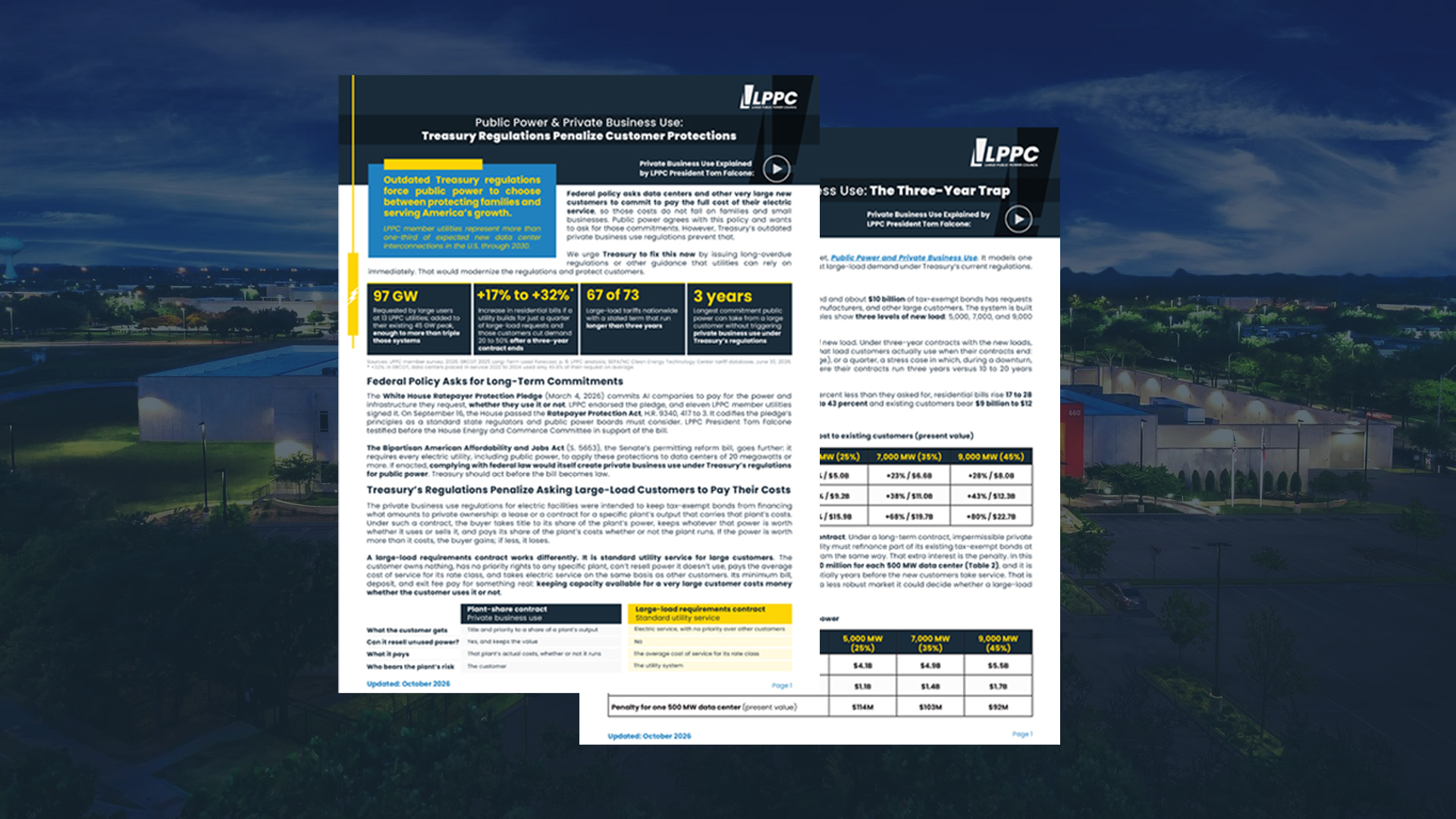
- Case study: The Three-Year Trap. Our new analysis models what three-year and long-term contracts would cost an illustrative system and the 13 LPPC members facing the most demand. Read the case study →
- Fact sheet: Public Power and Private Business Use. A two-page overview of the problem, the numbers, and the fix. Download the fact sheet →
- Updated regulatory text. Our proposed revision to Treasury's private business use regulations would restore the pre-2002 treatment of large-load contracts. View the regulatory text →


